Category: Uncategorized

  • Procurement Rice Intelligence Report — October 16, 2026

    Procurement Rice Intelligence Report — October 16, 2026

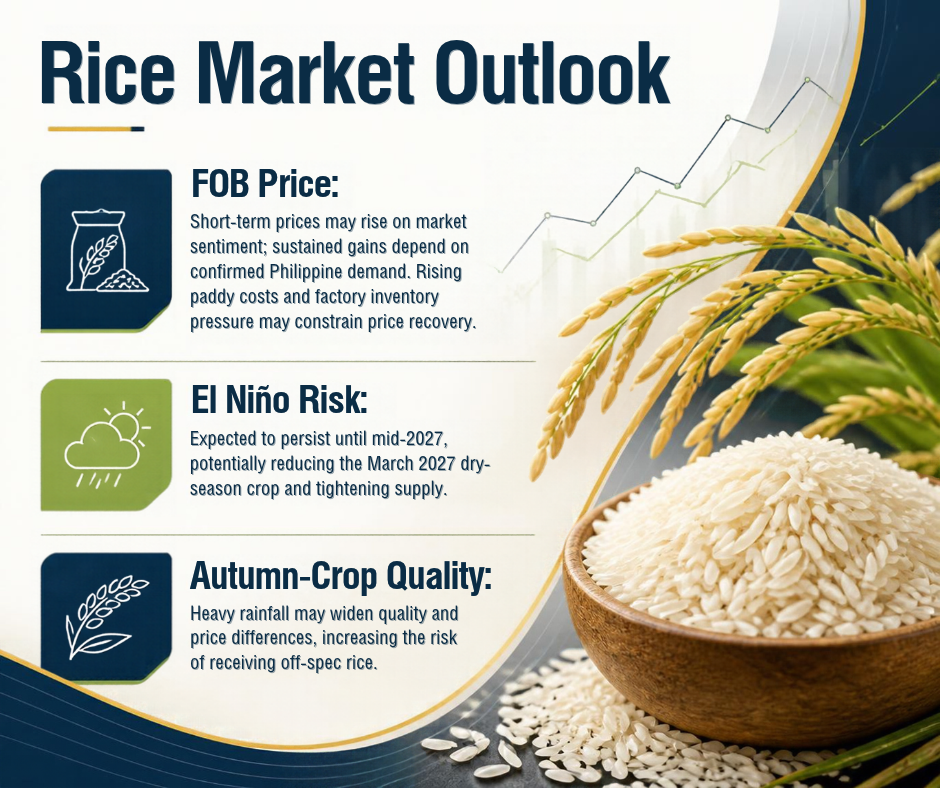
    • FOB Price: Short-term prices may rise on market sentiment; sustained gains depend on confirmed Philippine demand.
    • Rising paddy costs and limited available material pressure may improve price recovery in Nov 2026 to January 2027.
    • El Niño Risk:: Expected to stronger in Nov and persist until mid-2027, potentially reducing the March 2027 dry-season crop and tightening supply.
    • Autumn-Crop Quality: Heavy rainfall may widen quality and price differences, increasing the risk of receiving un-expect rice.
    Rice Procurement Risk Alert | 10–16 October 2026 | Lily Foods
    Lily Foods · Rice Procurement Intelligence
    16 October 2026

    Buyer risk alert · Vietnam rice

    Four risks could reshape buying costs, supply and quality.

    The priority is to act before higher raw-material costs, stronger Philippine demand, El Niño-related crop pressure or rain-damaged quality are fully reflected in supplier offers and shipped cargo.

    10–16 October 2026 Buyer-side assessment Early action required

    Key procurement warning: Raw-material cost pressure and improving Philippine import demand may reinforce each other, creating a risk of rapid FOB increases from November 2026 to January 2027. Importers should review coverage early while tightening lot-level quality checks.

    01 · Risk exposure

    Four risks importers should prepare for now

    Risk direction is based on current market observations and forward-looking estimates. Forecasts may change as new data emerges.

    RISK 01
    High · Near-term cost pressure

    Fragrant rice: raw-material costs may rise before FOB prices catch up

    Prices of fragrant-rice paddy may increase ahead of export-price recovery. This creates a lag between mill replacement costs and current FOB offers. Once mills adjust their quotations, buyers may face a sudden cost reset and shorter price validity.

    Early warningPaddy offers continue to rise while FOB quotations remain unchanged; mills shorten quote validity, withdraw offers or increase prices on new enquiries.
    Act earlyRefresh mill-level offers frequently. Calculate the gap between raw-material costs and FOB prices, secure essential near-term volume in stages and avoid relying on an outdated quotation.
    RISK 02
    Forward risk · Crop / supply

    El Niño may put pressure on the March 2027 dry-season crop

    Current expectations point to El Niño conditions lasting into around mid-2027. If the forecast holds, lower rainfall and water stress could slow or reduce output from Vietnam’s March 2027 dry-season crop, tightening supply later in the procurement cycle.

    Early warningEl Niño forecasts strengthen or persist; rainfall, irrigation-water availability, crop condition or official yield expectations deteriorate in key growing areas.
    Prepare forward coverageTrack weather and crop updates through the growing season. Review requirements extending into and beyond March 2027, secure critical volume progressively and avoid dependence on a single sourcing window.
    RISK 03
    High · Near-term FOB upside

    Philippine import demand is showing clearer signs of strengthening

    Philippine demand signals point to higher import requirements. El Niño-related concerns may reduce year-end main-crop output by an estimated 700,000 MT, increasing the need for imported rice. Stronger buying interest could quickly lift Vietnam FOB prices, especially from November 2026 to January 2027.

    Early warningMore Philippine import tenders, purchase enquiries, import approvals or confirmed buying volumes; Vietnamese suppliers begin raising FOB offers or limiting shipment allocations.
    Move before repricing acceleratesReview stock cover and confirmed sales now. Obtain updated FOB offers, prioritize essential shipment requirements and secure volume in tranches rather than waiting for the full demand increase to appear in market prices.
    RISK 04
    High · Quality / claim risk

    Heavy rain may create uneven quality in Autumn-crop rice

    Heavy rainfall during the Autumn crop may affect grain maturity, appearance and milling quality. Quality differences between lots can widen, with corresponding price gaps. Importers may receive rice that does not perform or look as expected if purchasing decisions rely only on general samples or supplier descriptions.

    Early warningHigher moisture, yellow or immature kernels, inconsistent grain appearance, elevated broken ratio or material differences between the approved sample and the actual production lot.
    Strengthen lot-level controlApprove representative samples, define measurable tolerances in the contract and inspect the actual lot before loading. Check moisture, broken percentage, defects, colour and consistency; hold or reject cargo that falls outside agreed specifications.

    02 · Early response

    What importers should do now

    Procurement priority

    Secure essential volume before repricing. Protect quality before loading.

    The immediate focus is to manage the possible November 2026–January 2027 FOB increase while preparing for crop and quality uncertainty into 2027.

    1

    Recheck fragrant-rice replacement cost

    Collect fresh paddy and mill offers. Watch whether raw-material costs are moving faster than export prices and whether quotation validity is shortening.

    2

    Bring forward essential purchases

    Review stock cover and shipment lead time. Secure confirmed requirements in tranches before stronger Philippine demand is fully reflected in FOB offers.

    3

    Plan beyond the March 2027 crop

    Monitor El Niño, rainfall and crop conditions. Reassess sourcing and forward coverage as the March 2027 dry-season harvest approaches.

    4

    Inspect the actual Autumn-crop lot

    Do not rely on a generic sample alone. Confirm lot-specific moisture, broken ratio, colour, immature/yellow kernels and consistency before loading.

    03 · Warning signals

    Signals that should trigger an immediate response

    Use observable changes to update purchase timing, volume and inspection intensity.

    Paddy prices rise while fragrant-rice FOB remains flatRefresh mill quotations, review the replacement-cost gap and secure essential volume before mills reprice export offers.
    Philippine buying activity strengthensCheck confirmed tenders, import approvals and purchase volumes; review stock cover and bring forward essential purchases if the market tightens.
    El Niño outlook or crop conditions deteriorateReassess supply assumptions for the March 2027 dry-season crop and progressively secure requirements extending into the later shipment window.
    Autumn-crop sample differs from the production lotIncrease inspection intensity. Hold loading until moisture, broken ratio, defects, colour and agreed tolerances are verified.

    04 · Time-based risk matrix

    When risk may intensify — and what should trigger action

    Qualitative planning assessment, not statistical probabilities. Update as market and crop evidence changes.

    RiskNext 1–4 weeksNext 1–3 monthsVariables that confirm / weaken the riskDecision response
    1. FOB price increase
    Raw-material cost + Philippine demand
    MEDIUM
    Cost pressure may begin feeding into mill offers; price validity may shorten.
    MEDIUM–HIGH
    Risk of faster FOB repricing, especially Nov 2026–Jan 2027, if buying demand strengthens.
    Paddy and mill replacement costs; DT8 / fragrant-rice FOB offers; quote validity; Philippine tenders, approvals and confirmed purchases.Secure in tranches: cover confirmed requirements early; avoid speculative overbuying and reprice each tranche.
    2. Quality shortage / inconsistency
    Autumn-crop rain impact
    MEDIUM
    Quality variation may already be visible between lots.
    HIGHER IF DAMAGE PERSISTS
    Usable supply may tighten and quality premiums may widen.
    Milling recovery; moisture; broken ratio; immature/yellow kernels; defects; consistency between approved sample and shipment lot.Buy by verified lot: require representative samples and pre-loading inspection; do not rely on grade name or indicative price alone.
    3. Philippine import demandMEDIUM
    Demand signals may influence supplier sentiment before volumes fully materialize.
    MEDIUM–HIGH
    Confirmed buying could accelerate regional competition and Vietnam FOB increases.
    Actual imports; tenders and awards; import permits; buyer enquiries converted to orders; Philippine stock and crop estimates.Watch confirmation: increase coverage when tenders convert into purchases or supplier offers tighten, not on headlines alone.
    4. El Niño / March 2027 dry-season cropWATCH
    Forecast persistence is an early warning, not yet proof of lower output.
    MEDIUM–HIGHER
    Crop and water-stress evidence may begin to change forward supply expectations.
    ENSO updates; rainfall and irrigation availability; water levels; crop progress; official yield and production revisions.Prepare forward: review supply needs beyond March 2027; diversify sourcing windows and update coverage as crop evidence develops.
    5. Freight & shipment execution
    Secondary watchlist
    LOW–MEDIUM
    No clear escalation established from the current data.
    UNCLEAR
    Exposure depends on vessel space, equipment and route conditions.
    Actual freight offers; vessel schedules; container availability; port congestion; transit-time changes and carrier notices.Verify before commitment: compare current freight and sailing options; do not assume freight remains stable through shipment.
    How to use this matrix: Act when observable confirmation variables move, not simply because a risk is listed. Bring purchases forward when cost and demand signals strengthen together; tighten inspection when lot quality becomes inconsistent; expand forward coverage only as crop evidence supports a tighter supply outlook.

    Assessment discipline: The 700,000 MT Philippine main-crop reduction and El Niño persistence through around mid-2027 are forward-looking estimates, not confirmed outcomes. The freight assessment is provisional because no current route-specific freight or vessel data has been provided. Risk levels are qualitative and should be reviewed weekly.

    Reporting note

    Scope & limitations

    Assessment focus: Fragrant-rice raw-material costs, El Niño-related crop exposure, Philippine import demand and Autumn-crop quality risks. This brief prioritizes procurement decisions rather than broad market commentary.

    Data discipline: The timing and scale of El Niño impacts, the Philippine crop estimate and the resulting import demand may change. Treat them as risk indicators and verify against updated official information before making a firm purchasing commitment.

    Disclaimer: This brief supports procurement planning only. It is not a firm offer or a guarantee of future prices, production, demand or quality. Confirm supplier quotations and lot-specific specifications before contracting or shipment.
    © 2026 Lily Foods · Rice Procurement Intelligence Buyer risk alert · 10–16 October 2026 · For information purposes only
  • How Will Super El NINO Impact Rice Supplies for June 2026 Crop?

    Executive Summary

    A powerful “Super El Niño” is expected to severely disrupt agricultural production in key exporting regions such as Australia, Southeast Asia, and India. This report examines the likely impact on the June 2026 harvest and how reduced output could drive up global rice prices and strain supply chains.

    1. Current Global Impacts of Super El Nino

    The effects of this climate phenomenon are already being felt across major producing regions:

    Figure 1: Global temperature map and key rice-producing regions at risk (Source: Forecast Model)

    • Australia: Severe drought conditions driven by El Niño are forcing farmers to scale back on seeding for new crops, leading to lower yield projections.
    • India: As a top rice exporter, India faces a dual threat to its rice and soybean production, raising concerns about future export bans or restrictions.
    • Southeast Asia:
      • Rice & Palm Oil: Prolonged El Niño cycles are expected to slash palm oil production by 5% to 12%.
      • Vietnam & Thailand: Extreme heat and salt intrusion are threatening core rice-growing deltas.
    • China: Paradoxically, El Niño brings the risk of severe flooding in Southeast China, potentially ruining vegetable and rice harvests during the peak season.

    2. Deep Dive Super El Nino: The Philippines’ Rice Crisis (June 2026 Forecast)

    The Philippines is a “canary in the coal mine” for global rice demand. The upcoming wet season crop, which typically accounts for 55% of national output, is at extreme risk.

    Production Decline vs. Import Requirements

    According to industry experts in Ho Chi Minh City, the drop in local production will force a massive surge in import volumes. Based on data from S&P Global, we can project:

    Figure 2: Analysis of Philippine rice import scenarios based on production decline levels.

    Output DropEstimated Import Need (Million MT)Comparison to 2024 Record (4.8M MT)
    -10%4.6 Million MTNormalization
    -20%5.2 Million MTBreaking Records
    -30%5.6 Million MTHigh Alert
    -50%6.9 Million MTCrisis Level

    3. The “Worst-Case Scenario”: Supply Shortages in Super El Nino

    By the second half of 2026, the Philippines may attempt to import 6 to 8 million metric tons to stabilize domestic prices. However, market analysts warn of a “Supply Wall”:

    Figure 3: Forecast of global rice prices approaching $1,000/ton due to supply shortages.

    • Availability: Global exporters may not have the capacity to supply an additional 6-8 million MT, regardless of price.
    • Price Surge: We could see rice prices skyrocketing toward $1,000/MT, a level unseen in modern history.
    • Global Security: This scenario poses a direct threat to Food Security in Africa, as nations there compete with wealthier Asian importers for dwindling stocks.

    4. Lessons from 2024 El Nino

    The 2024 El Niño caused approximately 57.78 billion Philippine pesos (about US$939 million) in agricultural losses in the Philippines.

    If the 2026 event evolves into a stronger Super El Niño, total damages could be more

    Conclusion: Prepare Before the Market Reacts With Super El Nino

    Super El Niño 2026 could become one of the most disruptive events in the global rice market in recent years.

    If production declines simultaneously across major exporting countries while import demand surges, the market may face:

    • Rice prices SURGE
    • Severe supply shortages
    • Heightened global food security risks

    Governments, importers, and exporters should begin strategic stockpiling and risk planning now to mitigate the potential food crisis in 2026.

  • How to Buy Vietnam Rice with Confidence: Importer Tips and Quality Standards

    How to Buy Vietnam Rice with Confidence: Importer Tips and Quality Standards

    Rice grains and export quality concept

    How to Buy Vietnamese Imported Rice with Confidence

    Clear buyer tips, key rice standards, and a downloadable reference guide for importers.

    Buying rice from Vietnam is easier when you focus on three things: clear specifications, reliable inspection, and shipment planning. This short guide helps importers compare suppliers and understand the basic standards for major rice types.

    What buyers should check first

    • Product specification: broken rate, moisture, grain length, purity, aroma, and milling level.
    • Factory and inspection: audit the supplier, verify samples, and inspect before loading.
    • Supply continuity: confirm crop season, lead time, and shipment schedule early.
    • Total buying cost: compare quality and logistics, not price alone.

    Rice standards at a glance

    • Jasmine rice: fragrant long grain, usually 5% max broken, 14.5% max moisture, soft and slightly sticky after cooking.
    • ST25 rice: premium fragrant rice with long grain, high eating quality, and strong premium-market appeal.
    • KDM rice: aromatic rice often chosen by buyers looking for a profile close to Hom Mali style.
    • Japonica rice: short round grain with a soft, chewy texture for markets that prefer stickier cooked rice.
    • Brown rice: keeps the bran layer, light golden color, and stronger nutrition positioning.
    • Glutinous rice: high stickiness, suitable for cakes, noodles, and specialty food applications.

    Simple buying tips

    • Ask for a written specification sheet for every rice type.
    • Confirm crop season and origin before negotiating volume.
    • Require pre-loading inspection and loading supervision.
    • Check packing, weighing, container cleanliness, and shipment timing.
    • Choose a supplier that can support both quality control and logistics coordination.

    Download the full guide

    For a more detailed reference on importer priorities and rice standards, download the PDF below.

    Need sourcing support from Vietnam?

    Lily Foods supports importers with rice sourcing, on-site quality control, and logistics management from Vietnam. If you want help comparing suppliers or reducing buying risk, request a quote.