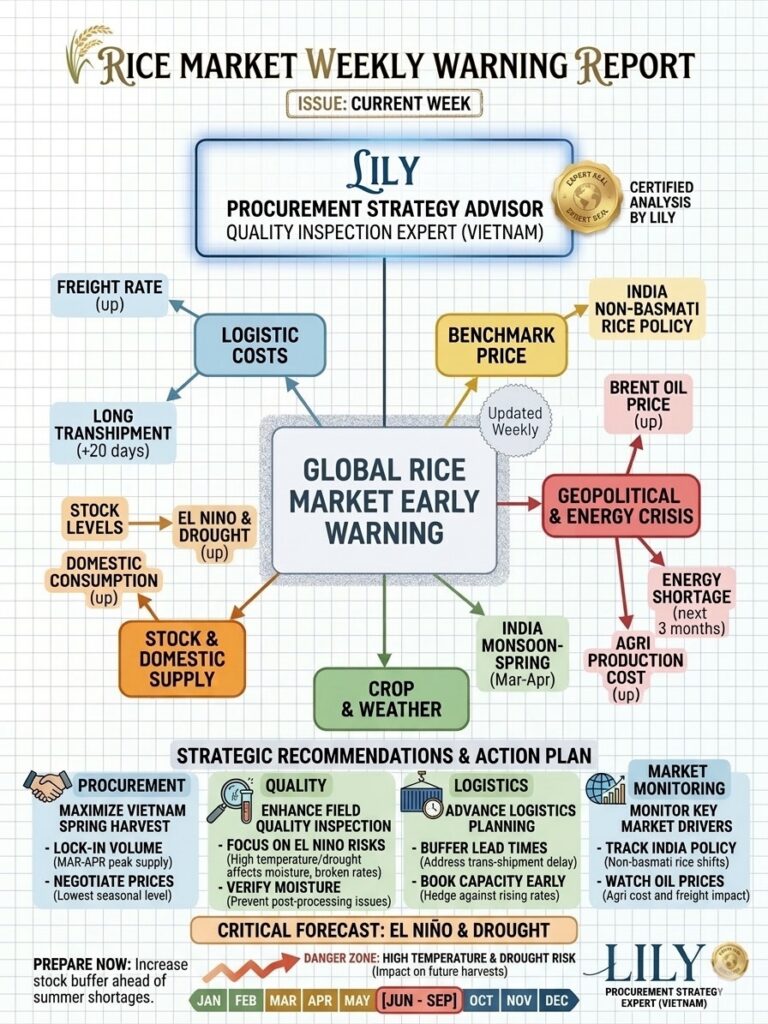
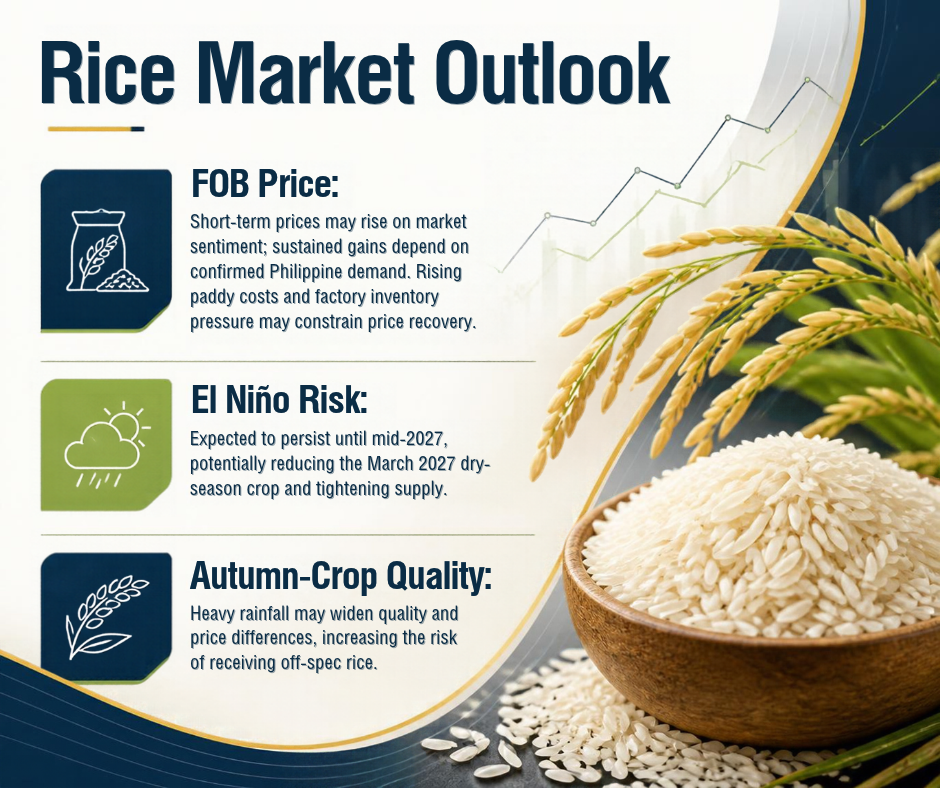
- FOB Price: Short-term prices may rise on market sentiment; sustained gains depend on confirmed Philippine demand.
- Rising paddy costs and limited available material pressure may improve price recovery in Nov 2026 to January 2027.
- El Niño Risk:: Expected to stronger in Nov and persist until mid-2027, potentially reducing the March 2027 dry-season crop and tightening supply.
- Autumn-Crop Quality: Heavy rainfall may widen quality and price differences, increasing the risk of receiving un-expect rice.
Buyer risk alert · Vietnam rice
Four risks could reshape buying costs, supply and quality.
The priority is to act before higher raw-material costs, stronger Philippine demand, El Niño-related crop pressure or rain-damaged quality are fully reflected in supplier offers and shipped cargo.
Key procurement warning: Raw-material cost pressure and improving Philippine import demand may reinforce each other, creating a risk of rapid FOB increases from November 2026 to January 2027. Importers should review coverage early while tightening lot-level quality checks.
01 · Risk exposure
Four risks importers should prepare for now
Risk direction is based on current market observations and forward-looking estimates. Forecasts may change as new data emerges.
Fragrant rice: raw-material costs may rise before FOB prices catch up
Prices of fragrant-rice paddy may increase ahead of export-price recovery. This creates a lag between mill replacement costs and current FOB offers. Once mills adjust their quotations, buyers may face a sudden cost reset and shorter price validity.
El Niño may put pressure on the March 2027 dry-season crop
Current expectations point to El Niño conditions lasting into around mid-2027. If the forecast holds, lower rainfall and water stress could slow or reduce output from Vietnam’s March 2027 dry-season crop, tightening supply later in the procurement cycle.
Philippine import demand is showing clearer signs of strengthening
Philippine demand signals point to higher import requirements. El Niño-related concerns may reduce year-end main-crop output by an estimated 700,000 MT, increasing the need for imported rice. Stronger buying interest could quickly lift Vietnam FOB prices, especially from November 2026 to January 2027.
Heavy rain may create uneven quality in Autumn-crop rice
Heavy rainfall during the Autumn crop may affect grain maturity, appearance and milling quality. Quality differences between lots can widen, with corresponding price gaps. Importers may receive rice that does not perform or look as expected if purchasing decisions rely only on general samples or supplier descriptions.
02 · Early response
What importers should do now
Procurement priority
Secure essential volume before repricing. Protect quality before loading.
The immediate focus is to manage the possible November 2026–January 2027 FOB increase while preparing for crop and quality uncertainty into 2027.
Recheck fragrant-rice replacement cost
Collect fresh paddy and mill offers. Watch whether raw-material costs are moving faster than export prices and whether quotation validity is shortening.
Bring forward essential purchases
Review stock cover and shipment lead time. Secure confirmed requirements in tranches before stronger Philippine demand is fully reflected in FOB offers.
Plan beyond the March 2027 crop
Monitor El Niño, rainfall and crop conditions. Reassess sourcing and forward coverage as the March 2027 dry-season harvest approaches.
Inspect the actual Autumn-crop lot
Do not rely on a generic sample alone. Confirm lot-specific moisture, broken ratio, colour, immature/yellow kernels and consistency before loading.
03 · Warning signals
Signals that should trigger an immediate response
Use observable changes to update purchase timing, volume and inspection intensity.
04 · Time-based risk matrix
When risk may intensify — and what should trigger action
Qualitative planning assessment, not statistical probabilities. Update as market and crop evidence changes.
| Risk | Next 1–4 weeks | Next 1–3 months | Variables that confirm / weaken the risk | Decision response |
|---|---|---|---|---|
| 1. FOB price increase Raw-material cost + Philippine demand | MEDIUM Cost pressure may begin feeding into mill offers; price validity may shorten. | MEDIUM–HIGH Risk of faster FOB repricing, especially Nov 2026–Jan 2027, if buying demand strengthens. | Paddy and mill replacement costs; DT8 / fragrant-rice FOB offers; quote validity; Philippine tenders, approvals and confirmed purchases. | Secure in tranches: cover confirmed requirements early; avoid speculative overbuying and reprice each tranche. |
| 2. Quality shortage / inconsistency Autumn-crop rain impact | MEDIUM Quality variation may already be visible between lots. | HIGHER IF DAMAGE PERSISTS Usable supply may tighten and quality premiums may widen. | Milling recovery; moisture; broken ratio; immature/yellow kernels; defects; consistency between approved sample and shipment lot. | Buy by verified lot: require representative samples and pre-loading inspection; do not rely on grade name or indicative price alone. |
| 3. Philippine import demand | MEDIUM Demand signals may influence supplier sentiment before volumes fully materialize. | MEDIUM–HIGH Confirmed buying could accelerate regional competition and Vietnam FOB increases. | Actual imports; tenders and awards; import permits; buyer enquiries converted to orders; Philippine stock and crop estimates. | Watch confirmation: increase coverage when tenders convert into purchases or supplier offers tighten, not on headlines alone. |
| 4. El Niño / March 2027 dry-season crop | WATCH Forecast persistence is an early warning, not yet proof of lower output. | MEDIUM–HIGHER Crop and water-stress evidence may begin to change forward supply expectations. | ENSO updates; rainfall and irrigation availability; water levels; crop progress; official yield and production revisions. | Prepare forward: review supply needs beyond March 2027; diversify sourcing windows and update coverage as crop evidence develops. |
| 5. Freight & shipment execution Secondary watchlist | LOW–MEDIUM No clear escalation established from the current data. | UNCLEAR Exposure depends on vessel space, equipment and route conditions. | Actual freight offers; vessel schedules; container availability; port congestion; transit-time changes and carrier notices. | Verify before commitment: compare current freight and sailing options; do not assume freight remains stable through shipment. |
Assessment discipline: The 700,000 MT Philippine main-crop reduction and El Niño persistence through around mid-2027 are forward-looking estimates, not confirmed outcomes. The freight assessment is provisional because no current route-specific freight or vessel data has been provided. Risk levels are qualitative and should be reviewed weekly.
Reporting note
Scope & limitations
Assessment focus: Fragrant-rice raw-material costs, El Niño-related crop exposure, Philippine import demand and Autumn-crop quality risks. This brief prioritizes procurement decisions rather than broad market commentary.
Data discipline: The timing and scale of El Niño impacts, the Philippine crop estimate and the resulting import demand may change. Treat them as risk indicators and verify against updated official information before making a firm purchasing commitment.
Disclaimer: This brief supports procurement planning only. It is not a firm offer or a guarantee of future prices, production, demand or quality. Confirm supplier quotations and lot-specific specifications before contracting or shipment.